NGC Aerospace Advances Autonomous Spacecraft Control for Very Low Earth Orbit (VLEO)
NGC Aerospace has successfully completed the RAVELO (Robust Attitude and Orbit Control System for Very Low Earth Orbit) study for the European Space Agency (ESA), demonstrating a new generation of autonomous guidance, navigation, and control capabilities tailored for operation in Very Low Earth Orbit.
Unlocking the Potential of VLEO
VLEO is emerging as a high-value operational regime for both telecommunications and Earth observation missions. Its reduced altitude enables improved signal performance, lower latency, higher imaging resolution, and significantly reduced payload mass and power requirements. Additionally, strong atmospheric drag enables rapid post-mission deorbiting, contributing to more sustainable space operations.
Although advantageous at the end of life, the strong aerodynamic perturbations need to be mitigated during the operational life of spacecraft, introducing new technical challenges.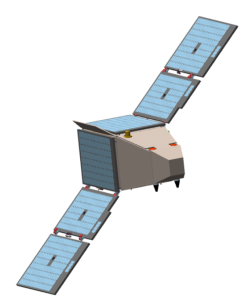
Fig. 1 – VLEO Spacecraft Concept (Redwire Space)
Transforming a Perturbation into a Control Resource
A key innovation of the RAVELO program is the shift from resisting atmospheric effects to actively exploiting them. The developed system leverages aerodynamic forces as part of the control strategy, enabling new operational concepts:
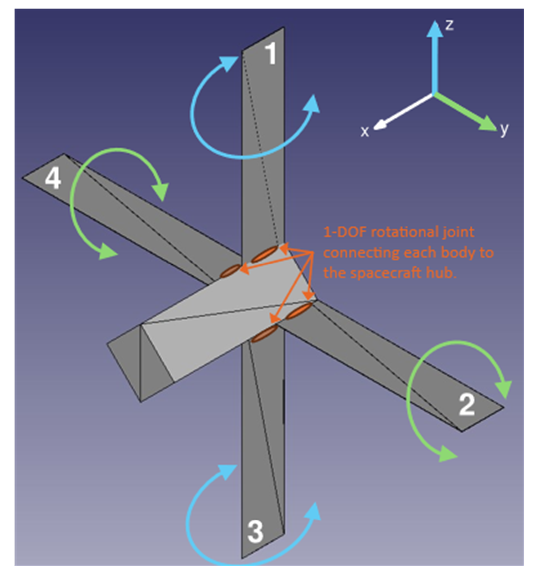
- Aerodynamic attitude control using control surfaces, enabling full three-axis control without conventional attitude control actuators (e.g., reaction wheels) for low-altitude missions
- Aerodynamic momentum management, allowing reaction wheels to be unloaded using atmospheric torque rather than dedicated hardware (e.g., magnetic torque rods)
- Integration of air-breathing electric propulsion (ABET), which exploit the thin atmospheric density in VLEO by using atmospheric particles as propellant in an electric thruster to counteract drag
These innovations redefine the architecture of spacecraft control systems in VLEO and introduce new design trades between conventional and unconventional actuators.
Advanced Autonomous AOCS Software
The updated design of Attitude and Orbit Control System (AOCS) Software, builds on NGC’s flight heritage while incorporating new VLEO-specific capabilities:
- Novel attitude guidance laws, including wind-relative flight, sun roll-steering, and ground-target roll-steering, which are all design to mitigate aerodynamic drag while achieving mission objectives
- Autonomous orbit control, continuously monitoring the current orbital state and commanding propulsion corrections without ground intervention
- Model-based and adaptive aerodynamic control algorithms, mapping desired torques into control surface actuation to realize aerodynamic attitude control
- On-board atmospheric modelling, enabling real-time estimation of density and airflow conditions
These capabilities enable fully autonomous spacecraft operations across the full range of VLEO altitudes.
Demonstrated Technical Outcomes
The RAVELO study achieved key results including:
- Reliable attitude control under VLEO conditions using both conventional and aerodynamic actuation
- Full aerodynamic-only attitude control
- Successful use of aerodynamic torque for reaction wheel unloading without magnetic actuators
- Autonomous orbit maintenance with both conventional and air-breathing electric propulsion
These results confirm the feasibility of sustained spacecraft operations in VLEO using advanced autonomous control strategies.
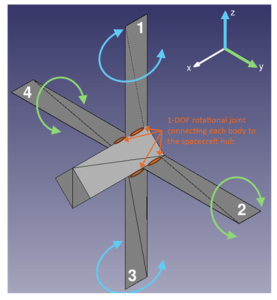
Fig. 2 – VLEO Spacecraft Concept with Aerodynamic Actuation
Path to Operational Deployment
The study concludes with a clear development roadmap, focusing on:
- Maturing aerodynamic control configurations and adaptive control algorithms
- Advancing air-breathing electric propulsion modelling and integration
- Refining aerodynamic-based momentum management
- Performing system-level trade-offs for future constellation applications
These next steps will enable the transition from validated concepts to flight-ready systems and support the industrialization of VLEO platforms.
NGC Aerospace’s RAVELO program demonstrates that VLEO is not only accessible but operationally advantageous when paired with innovative control technologies—paving the way for a new class of efficient and autonomous space missions.